





Visual Arts
Read More ›
Studio Sessions: Nakisa Dehpanah
Artist Nakisa Dehpanah’s new show uses suspended textile forms and movement to explore identity as something layered and always changing.
 By Sarah Stackhouse June 25, 2026

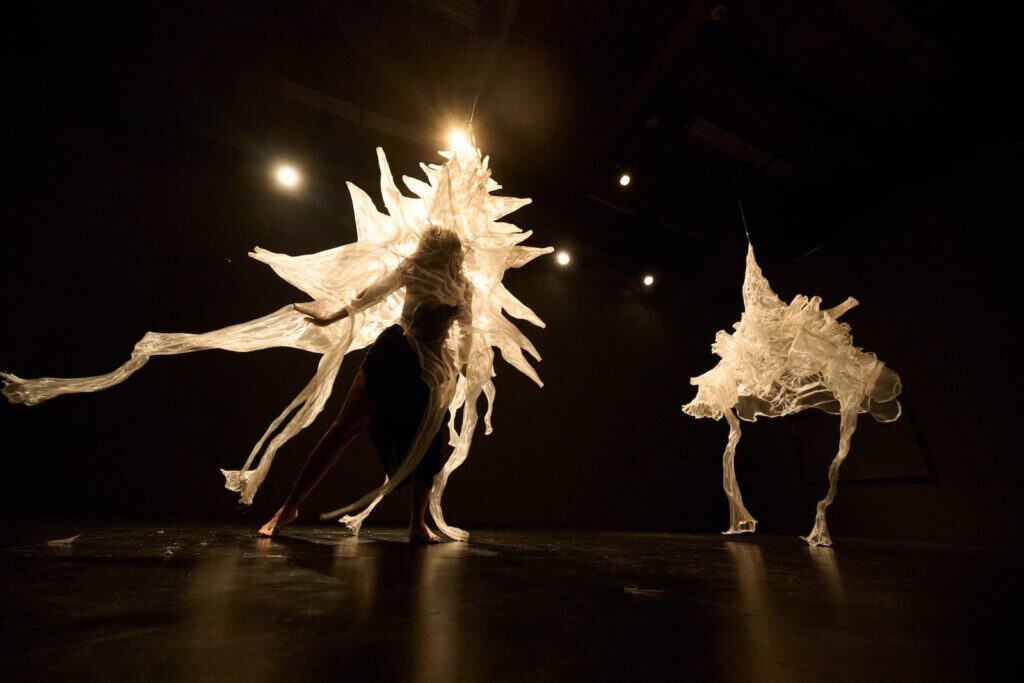
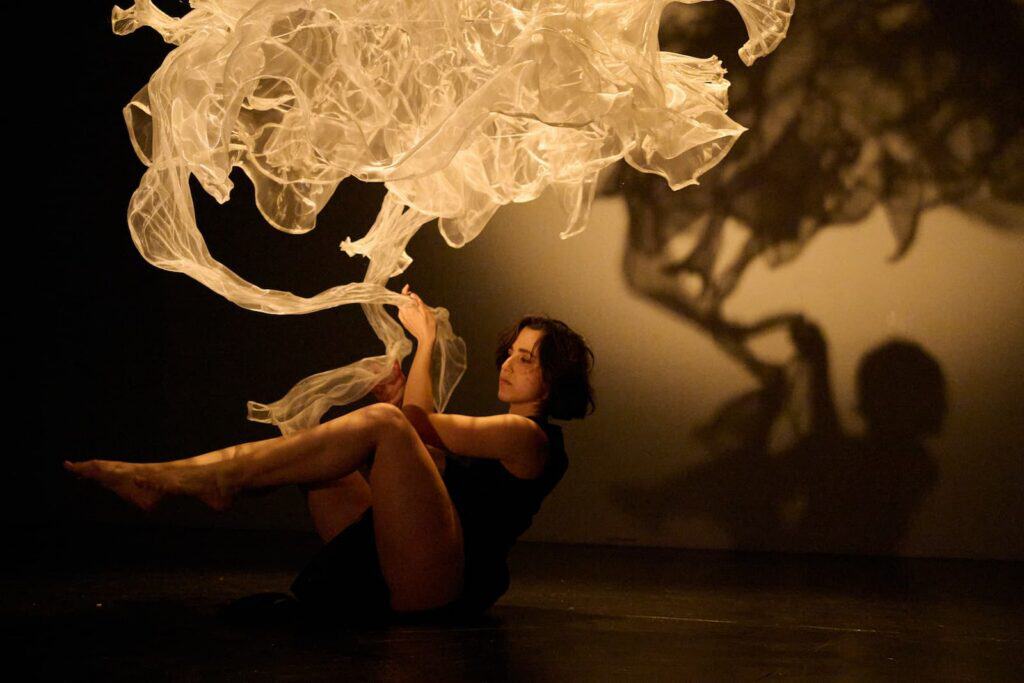
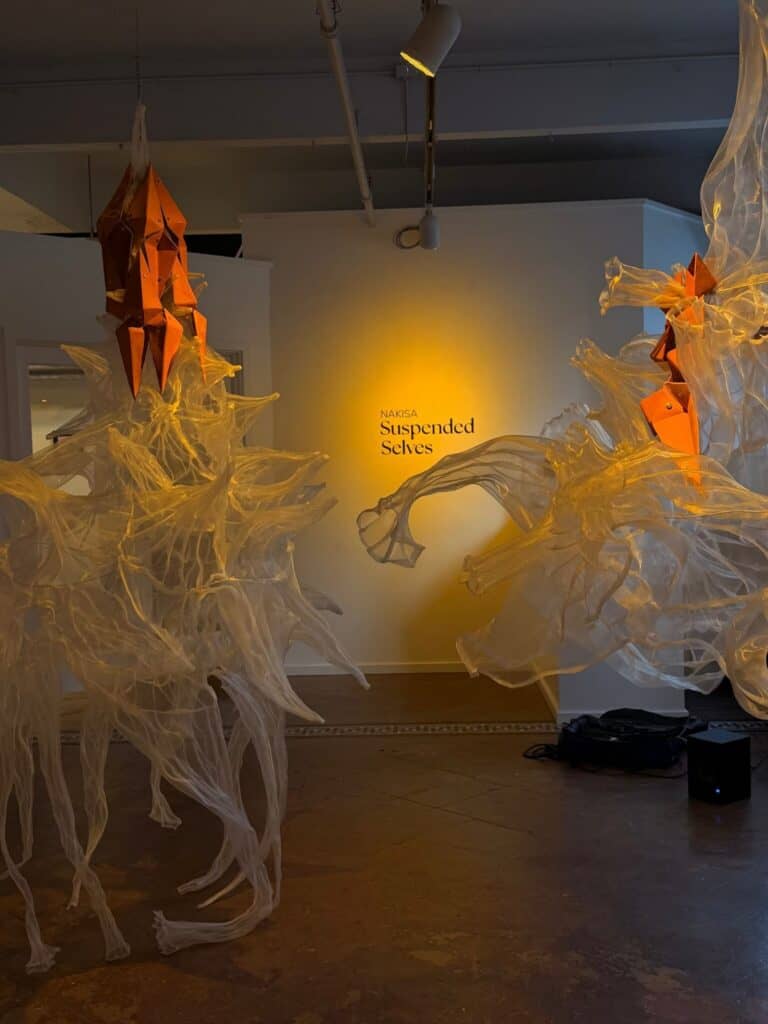
Seattle artist Nakisa Dehpanah’s work hovers between sculpture and performance. First developed during a residency at Base Art Space, Suspended Selves is now on view at Method Gallery in Pioneer Square, where billowy, vessel-like sheer fabric forms hang with geometric clay elements integrated into them. They seem like soft shelters or skins waiting for an inhabitant, or yearning for a previous one, but they also hold their own, like living creatures.
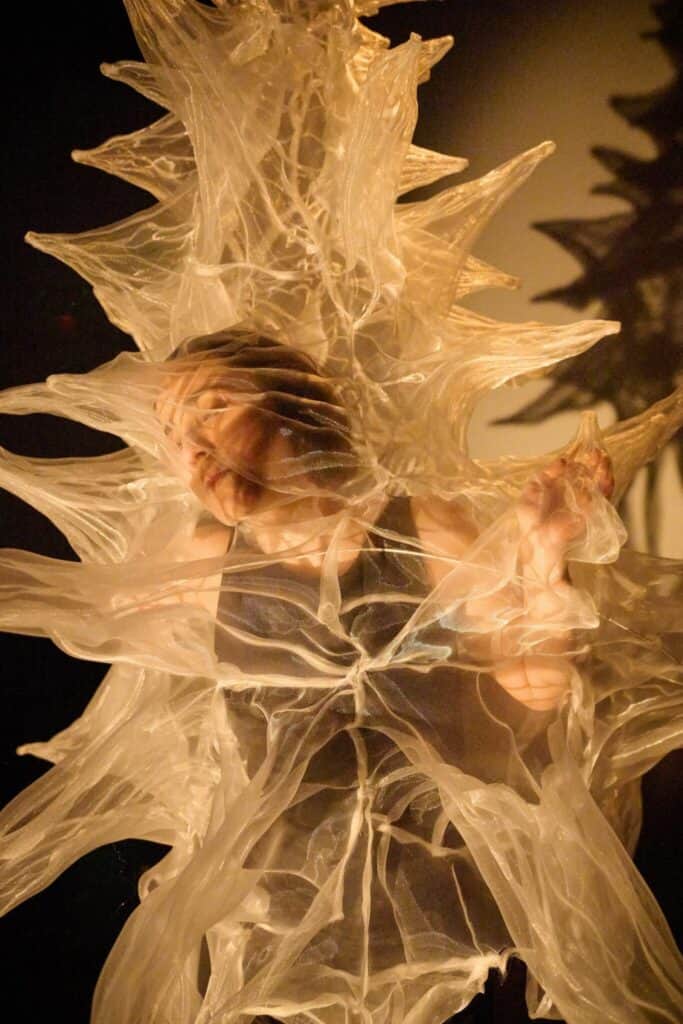
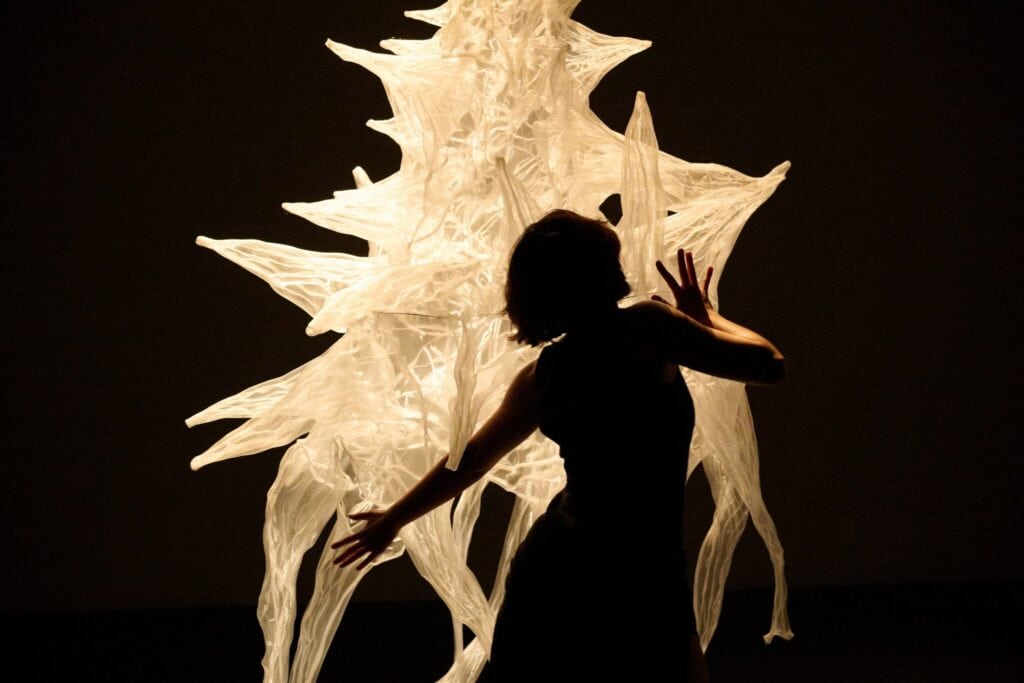
The installation has been activated through a series of performances, which can be viewed in a video of the work. Dehpanah moves in and out of the fabric, visible through the sheer material as she curls, reaches, folds, and emerges. It’s hard not to personify the forms. At times, she appears to be at what might be their feet, or holding their hands. Her fluid movement through them feels natural and cyclical, like a body finding and leaving its shell or skin. Each return suggests birth and becoming, but also the strange recognition of a self we once lived inside and no longer do. The performance also blurs the line between where the body ends and the surrounding world begins.
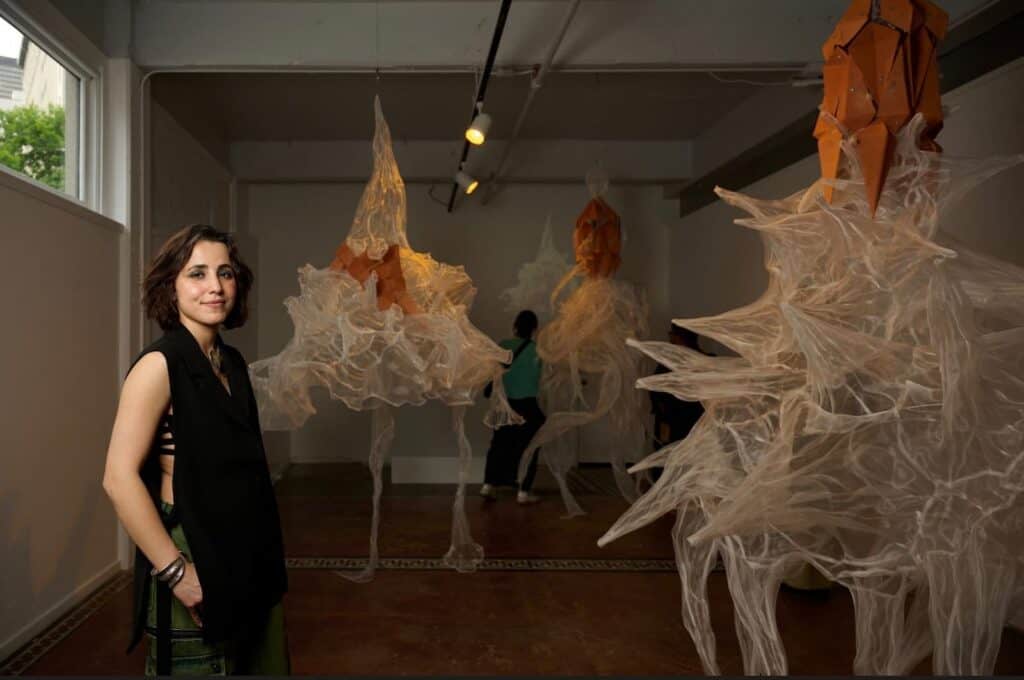
The exhibition opened June 4, on First Thursday, to a crowd of more than 1,000 people, a huge turnout for the gallery. Two days later, Dehpanah activated the structures in a performance with sound artist Maria Thran, inviting viewers to sit among the pieces.
“I want people to recognize themselves in the work,” Dehpanah says. “I am interested in the emotions and transformations that connect us, regardless of our individual stories.”
Though her sculptures and performances are shaped by her own experiences of memory, displacement, and becoming, she sees them as open invitations, a way for viewers to think about the changes and transformations in their own lives.
Born in Iran, Dehpanah grew up hiking and backpacking with her family in the northern mountains there, and that early connection to nature continues to shape her practice. She moved to the United States in 2016 to study architecture and sustainable design, a background that comes through in the way her work approaches structure and the body’s place within a space. Her influences range from Farsi literature and calligraphy to dance and poetry.
Dehpanah’s earlier show Rebel, presented in 2023, used fabric, movement, calligraphy, and sound to explore freedom and transformation. Suspended Selves builds from that, creating textile forms you can move around, look through, and wonder about long after you leave.
Video by Jacob Rosen.
Suspended Selves is on view at Method through July 25, with a closing artist talk at 1 p.m. that day.
Hometown:
Bojnord, Iran
Discipline:
Multidisciplinary artist
Favorite spot in Seattle:
Majnoon Cocktail Bar. My partner and I opened it last fall, and it has become a meaningful gathering space for us, our friends, and the neighborhood. I love seeing people connect, celebrate, and build community there.
Describe your work in three words.
Familiar. Strange. Becoming.
When did you know you wanted to be an artist?
It was never really a decision. I was painting large oil paintings when I was five years old and reciting poetry before I could even write. Architecture became another way of understanding space, form, and human experience. After the pandemic, I found myself drawing and performing again. Rather than choosing art, I felt like I was returning to something that had always been part of me.
Where do you find inspiration?
Nature, poetry, and people inspire me most. I am drawn to the ways landscapes and humans carry memory, accumulating layers of experience while continuously transforming. Poetry has always been my way of understanding the world. It teaches me that beauty and complexity, fragility and resilience, can coexist. Much of my work grows from these observations, exploring how identity is shaped by the forces around us while remaining fluid, adaptive, and always in the process of becoming.
What draws you to your particular medium?
I work between sculpture and performance because I am interested in forms that exist in states of transition. Textile allows for movement, adaptation, and transformation, while clay introduces weight, memory, and grounding. Together they create bodies that feel suspended between stability and change, which mirrors many of the themes I explore in my work. Poetry is also deeply embedded in my practice. It shapes how I think about rhythm, metaphor, and emotion, allowing me to create works that are not only seen, but felt.
Tell us about your proudest moment as an artist.
One of my proudest moments was during a performance of Suspended Selves at Method Gallery. Afterward, audience members approached me in tears. They didn’t know my personal story, yet they connected deeply with the emotions carried through the sculptures, movement, and sound. Moments like that remind me that art can communicate beyond language and biography.
Share one piece of advice you wish you knew when you were first starting out.
You are the creator, the destroyer, and the perceiver of your own reality.
What has been the biggest industry change you’ve noticed since the start of your career?
The biggest change has been the recognition that process, collaboration, and lived experience can be just as important as the final object. Audiences are increasingly interested in the stories, relationships, and communities that shape a work.
What do you still hope to accomplish?
I hope to continue expanding my knowledge of materials and deepen my research-driven practice. I want to create larger and more ambitious projects that bring together sculpture, performance, sound, and community engagement while continuing to explore themes of identity, transformation, and belonging.
Follow Us

WALKDONTRUN Returns This Saturday, Turning Downtown Seattle Into a Sprawling Art Show
In its second year, the free festival brings 200-plus artists to a 20-block route September 19, with a secret garden and a former 7-Eleven stocked with art.
Most walks through downtown Seattle involve trying to get somewhere. On September 19, the crosswalk itself might be the reason to stop. Heap Troupe will turn a four-way crossing into a performance, one of dozens of encounters planned for this year’s WALKDONTRUN. The free, all-ages art walk stretches across more than 20 blocks. From 11…

At Two Dot Schoolhouse, Ruth Marie Tomlinson Builds an Artistic Community
For nearly 20 years, the Seattle artist and her husband have welcomed artists, writers, and musicians to a historic Montana schoolhouse. Now they’re searching for its next stewards.
At her solo exhibition last year at The Vestibule, Seattle artist Ruth Marie Tomlinson presented a new series of work inspired by her close readings of British nature writer J.A. Baker’s The Peregrine and Icelandic author Sjón’s The Blue Fox. As if on sheets torn from a sketchbook, her pages included excerpts and outtakes of…

Rearview Mirror: Seahawks Off the Field, Seattle on the Board, and Smoked Oysters
Things I did, saw, ate, learned, or read in the past week (or so).
HOOKED ON KNOCKS Admittedly, I am late to this one. The Seahawks’ first season of Hard Knocks, the HBO series that follows NFL teams through training camp, premiered in August, but until last week, I had never heard of it. To be honest, my football knowledge starts with knowing what a touchdown is and doesn’t…

Studio Sessions: Colleen Louise Barry
Multi-hyphenate artist Colleen Louise Barry on discipline, the arts ecosystem in Seattle, and saving abandoned trampoline from the side of the road.
It’s hard not to smile around artist and writer Colleen Louise Barry. Bubbly and bright, she radiates optimism and cheer that would put most stereotypical Seattleites on edge. I think she is an absolute delight. Originally from Albany, Barry received her MFA from the University of Massachusetts, Amherst, before moving to Seattle in 2016. Once here,…