





News
Read More ›
A New Climate Fund Starts With Indigenous Leadership
The $5.5 million investment will support seven Tribal governments and Indigenous-led organizations working on climate projects across Greater Seattle and Puget Sound.
 By Sarah Stackhouse April 21, 2026

As we head into another summer of hotter days, drought, stress on waterways and habitat, and the now-familiar arrival of wildfire smoke, the First Peoples Climate Fund puts city and philanthropic money behind Native communities already doing the work of responding to these pressures, many of them closest to the impacts and with long-held knowledge of how to care for this region.
Created through Seattle’s Office of Sustainability & Environment in partnership with Seattle Foundation, the fund will support a wide range of work, including habitat restoration, building decarbonization, Native food and land stewardship, youth climate programs, workforce development, and energy upgrades tied to urban Native housing and services.
“The people who best know how to live with these lands are the folks who have lived in these lands with traditional knowledge passed down over thousands and thousands of years,” says Matt Remle, Lakota and a member of Seattle’s Green New Deal Oversight Board.
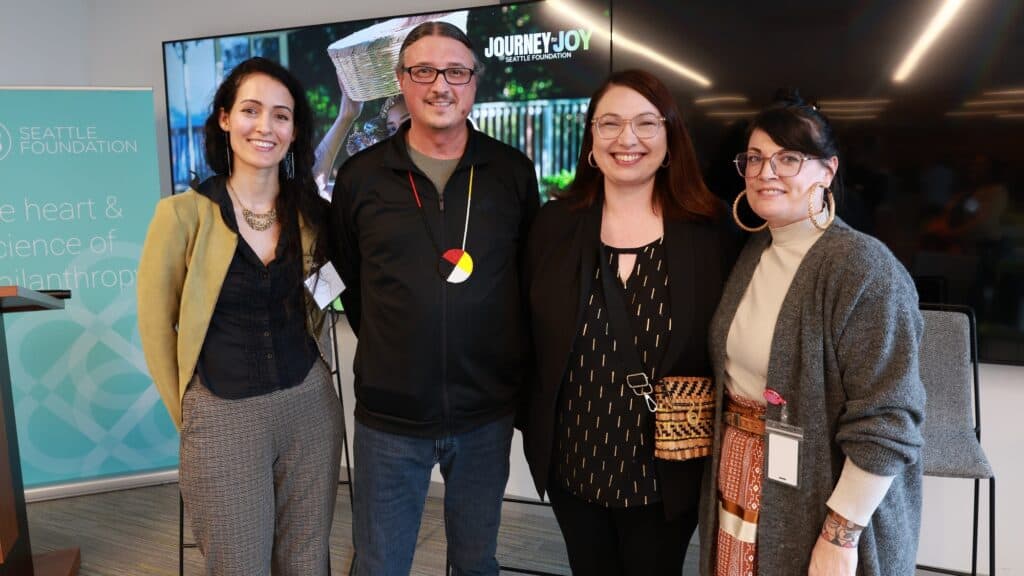
“While Indigenous communities may be on the front lines of impact,” says Seattle Foundation President and CEO Alesha Washington. “There’s also a reality that Indigenous communities have long been the authors of the solutions.”
The Suquamish Tribe will use its funding on efforts to reduce greenhouse gas emissions from tribal government buildings. Hannah Ljunggren, climate resiliency program manager for the tribe, says the grant will support building assessments, a new building decarbonization analyst, and workforce development tied to solar and other energy projects. “Being able to train tribal members on installing and maintaining solar panels creates opportunities not just for this particular individual who we’ll be hiring, but future generations as well,” she says.
For Feed Seven Generations, the grant will help keep Native climate work moving after the loss of other funding support. The organization’s work centers culturally rooted food and land stewardship. “They’re meeting us in the moment and mitigating the direct impact of funding loss,” says Romajean Thomas, a Muckleshoot tribal member and director of education and community engagement at the organization. “And so to be able to continue on with our 2026 climate work, even in the face of that funding loss, has been tremendously helpful.”
She says the work goes further than one grant cycle. “It has been taught to us that we take the knowledge from prior generations and bring it forward. We make sure it doesn’t just stay with us, but that it moves through the next seven generations and beyond.”
The other grantees are Snoqualmie Tribe, Cattail Rising, yəhaw̓ Indigenous Creatives Collective, Seattle Indian Services Commission, and Chief Seattle Club. Their work includes restoration planning along rivers and floodplains, land-based climate programs for Native youth, a Rainier Beach resilience hub and Indigenous Arts Campus, support for Native workers and entrepreneurs, and energy-efficient upgrades to Monterey Lofts alongside services for urban Native community members experiencing homelessness.
Follow Us

Remember When the Eastside Felt Like a Road Trip?
Months after the Sound Transit 2 Line began crossing Lake Washington, Seattle and the Eastside feel a whole lot closer.
There’s a particular kind of optimism and happiness you feel when a city decides to connect itself to its own future. World-class cities invest in the invisible things that make everything else possible. They make it easier for ideas to collide, for workers to access opportunity, for culture to flow. The East–West light rail Crosslake…


World Cup 26 Is Keeping the Region Busy. So Are Its Recycling Bins.
A local expert explains what actually happens after a plastic bottle leaves the bin.
Seattle is buzzing right now. In the first 11 days of World Cup 26, Waterfront Park recorded more than 451,000 visits, including nearly 85,000 on June 19 alone. SEA Airport has also seen some of its busiest travel days ever, with match-day crowds and summer travelers moving through the city. That is a lot of…

Washington’s Gender Wage Gap is Widening, Study Finds
Women earned $18,545 less than men in 2024, one of the widest disparities in the country.
The wage gap between men and women in Washington is the second widest in the country. An analysis released in March from the National Partnership for Women and Families found that women in Washington earned a median income $18,545 less than their male counterparts, the largest gap in the country second only to Utah. For…