





Seattle Artifact
Read More ›
Up In Smoke: The Little-Known Story of Seattle’s First Marijuana Initiative
A 1974 ballot campaign came up short, but helped set the stage for legal weed in Washington.

This article originally appeared in the March/April 2026 issue of Seattle magazine.
Like many American cities in the early 1970s, Seattle was once a hotbed of political and civil unrest. This era of discontent officially kicked off on May 5, 1970—one day after the Ohio National Guard shot students at Kent State University, killing four and wounding nine. In response, thousands of Seattle-area student protestors shut down the I-5 freeway and clashed with local police. The month before, a flamboyant activist group known as the Seattle Liberation Front was indicted by a grand jury for conspiracy to plan a riot, resulting in the highly publicized trial of the “Seattle Seven.” (One of the group’s members would later provide the inspiration for Jeff Bridges’ character in The Big Lebowski.) At the same time, the so-called Fort Lawton Occupation saw Native American activists take over the decommissioned U.S. Army base in Seattle to reclaim the land for Indigenous use.
Amidst this burst of local activism emerged another colorful group known as BLOSSOM. Formed in 1971, BLOSSOM stood for the Basic Liberation Of Smokers and Sympathizers Of Marijuana. While the BLOSSOM saga has been relegated to the dustbin of regional history, the group pioneered the way for Washington to become one of the first states to legalize the recreational use of marijuana.
BLOSSOM’s story begins in Thurston County. By 1971, the newly opened Evergreen State College, with its unconventional curriculum, had attracted a wide range of students from across the countercultural spectrum. As a result, the Olympia area became a popular destination for the hippie set, with the earliest version of BLOSSOM forming at a nearby commune. Led by noted community organizer Steve Wilcox, the group viewed marijuana as a sacrament, and according to group lore, it reportedly followed a ritual of continually passing a lighted joint around as though it were an eternal flame.
Sometime in early 1972, the group decided to attempt to legalize marijuana at the state level, and BLOSSOM was formally established. From headquarters in downtown Olympia, it began gathering enough signatures to put Washington State Initiative 264 on the ballot, which, if passed, would remove all penalties for the use and sale of marijuana as well as release all state prisoners who were convicted on marijuana charges. Once word of the project got out, other BLOSSOM chapters quickly formed in Seattle, Tacoma, and Spokane, helping to gather signatures and further the group’s mission.
Spirited fundraising rallies were held throughout the state, with many prominent speakers—from politicians to musicians—promoting the cause, but an unfortunate series of setbacks prevented the group from collecting the necessary number of signatures. Unable to get the initiative on the 1972 ballot, the core BLOSSOM group in Olympia disbanded, with many of its members quietly returning to life at their commune.
Meanwhile, in seattle, the fight for legal marijuana had only just begun. The city has always maintained a strong rebellious streak. From the Seattle General Strike of 1919 to the WTO Riots in 1999, Seattle has never been one to take things lying down. So, when BLOSSOM’s state initiative efforts fell apart, the Seattle chapter was more than ready to pick up the proverbial baton and continue running with it.
Taking inspiration from grassroots efforts such as the “Friends of the Market” campaign, which successfully saved Pike Place Market from demolition with a voter-approved initiative in 1971, BLOSSOM attempted the same thing with a local initiative that would permit adults to legally possess and sell marijuana within city limits. With the fuse now lit, work on the so-called Seattle BLOSSOM initiative began in early 1973.
Initially, key organizers, including Paul Elliot, Ralph “Geezer” Williamson, and Jim Klotz, met privately to hammer out a strategy and brainstorm the campaign’s direction. Afterward, they began recruiting an army of volunteers to help carry out the group’s mission of citywide legalization. Bright-yellow notices announcing upcoming organizational meetings were posted throughout the city, resulting in huge turnouts at overfilled community halls. Seattle, it seemed, was eager to legalize weed.
While the meetings were well attended, uniformed Seattle police officers—who had apparently taken notice of the flyers—also began showing up. These law enforcement intrusions were more amicable than expected. As one former BLOSSOM member, the aforementioned Jim Klotz, recalls, “one of the suits told us they appreciated we were working within the system and basically promised to leave BLOSSOM Seattle alone during the campaign. Apparently, they did so, as no encounters with the police occurred during the campaign that I recall. Of course, I suspect SPD kept an eye on us, nonetheless.”
With a growing army of volunteers, BLOSSOM began the laborious task of collecting the 20,000 signatures needed to get its initiative on the Seattle ballot. At the time, decriminalizing marijuana was a contentious issue, and for every positive comment that signature gatherers received, they were met with an equal amount of angry feedback. The volunteers quickly learned that there were good and bad places to petition, with any street corner near a bookstore or coffee shop becoming a favored spot. They also held a number of fundraisers featuring local bands and musicians at popular taverns and summertime street fairs.
In August 1973, BLOSSOM announced that it had successfully gathered enough signatures to put its initiative up for a vote in the upcoming spring election. This gave Seattle the distinction of being one of the first major cities to vote on the issue of decriminalizing marijuana. For the next several months, the initiative became the talk of the town; from spirited discussions at local lunch counters to radio DJs offering their two cents over the airwaves, everyone seemed to have an opinion on the matter.
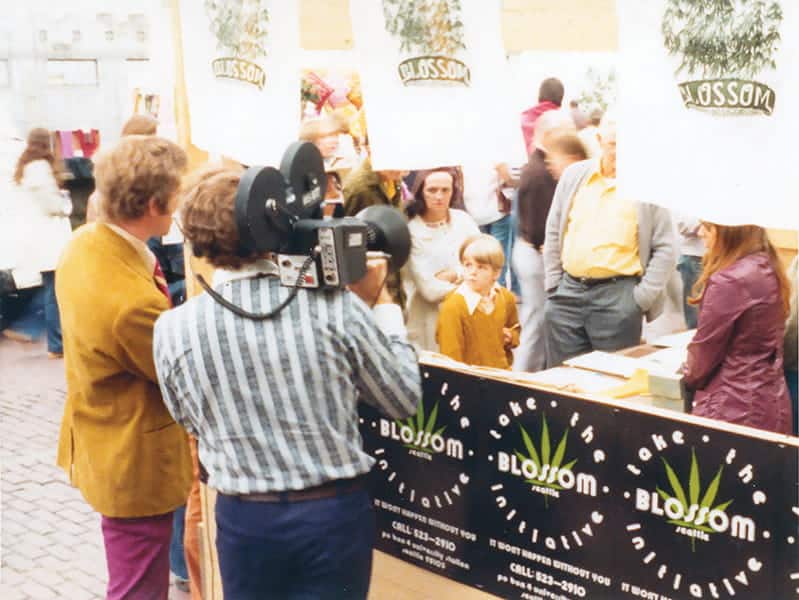
When election day finally arrived on March 26, 1974, local residents lined up to cast their votes with the ballot posing a simple yes-or-no question: “Shall the initiative measure providing for possession and distribution of marijuana without penalty be enacted as an ordinance?” After the polls closed that night, much of the city waited in anticipation to hear the results. The final tally was disappointing but not entirely surprising: By a 2-to-1 margin, the initiative was defeated with 55,287 votes against and 25,927 in support. At the time, Seattle was still a hard-drinking, blue-collar town that was not yet ready for legal weed.
After the vote, the Seattle BLOSSOM chapter disbanded, and its members went on to follow other pursuits. Founding BLOSSOM member Steve Wilcox became a revered community leader and helped form the Olympia Farmers Market. He passed away in 2017 at the age of 72. Seattle member Ralph “Geezer” Williamson became a world disc-golf champion who helped establish the Seattle Frisbee scene. He would tour the country to compete in freestyle Frisbee contests and became locally known for his audience-favorite performances at the halftime shows of various sporting events. Williamson died of cancer in 2011 at the age of 80. Surviving member Jim Klotz is a retired electric utility systems worker who still lives locally.
While BLOSSOM’s early attempts at marijuana reform were ultimately unsuccessful, it paved the way for all future efforts. In 2012, exactly forty years after BLOSSOM attempted to get Initiative 264 on the state ballot, Washingtonians would finally see the matter through when Initiative 502 was approved by popular vote, establishing Washington as one of the first states to legalize the use of marijuana for adults 21 years of age and older.
Brad Holden is an amateur historian and the author of two books: Seattle Prohibition: Bootleggers, Rumrunners and Graft in the Queen City, and Alfred M. Hubbard: Inventor, Bootlegger and Psychedelic Pioneer.
Follow Us

Seattle Breaks New Ground: Where Supercars, Superyachts, and Collectors Converge
Photos and video courtesy of Terminal One Seattle. On the shores of Salmon Bay, a new waterfront destination is bringing architecture, automotive culture, and the art of collecting together. Terminal One Motor + Yacht Club introduces a new category of luxury real estate with private condominium garages and future dockominiums. Forget everything you thought you…

When A Magazine Becomes A Place
An evening in Pioneer Square offers a reminder of how good it feels to connect—with old friends, new faces, and the city we call home.
A few months later, I’m still smiling! When we began planning Seattle magazine’s July/August Issue Launch party at RailSpur Alley in Pioneer Square, we hoped for a good crowd, some great conversations, and maybe one of those elusive Seattle summer evenings when the weather actually cooperates. What happened was something considerably better. Hundreds of people…

They betrayed you. Now what?
How do you fight hard against someone *and* still care for them? In Republican Mesa, Arizona, Julie Spilsbury was known for her council seat and her cinnamon rolls. When she endorsed Democrats, friends and neighbors who’d known her for decades launched a historic effort to kick her out of office. The man leading it did…

The Bark Benefit is changing lives, one rescue at a time
Every rescue dog has a story.
Tickets for The Bark Benefit are available now. September 19, 2026 | Meydenbauer Center Some animals arrive with broken bones or other medical needs. Others carry wounds that can’t be seen: fear, neglect, or trauma in need of healing. And then there are the dogs who have simply found themselves without a home because life…