




Elite Partners
Read More ›
Growing What Works: Early Outcomes from Washington’s Charter Public Schools

What happens after high school may be one of the most important measures of whether our public schools in Washington serve students well. A new report published by Agency, Inc, Turning the Tassel in Washington State: Outcomes for Charter Public School Graduates from 2019-2025, seeks to answer that question by exploring early adult life outcomes for public high school graduates who attended charter public schools.
Charter public schools—unique, open boundary public schools that operate independent of the school district—are relatively new to Washington state, with the first one opening in 2014 and the first class graduating in 2019.
Based on a national survey conducted by The Harris Poll of 5,000 recent public high school graduates, with an oversample of 400 Washington state graduates, the report shows early outcomes for Washington’s charter alumni are quite promising.
- Higher full-time employment (83%** vs. 62% of their district school peers)
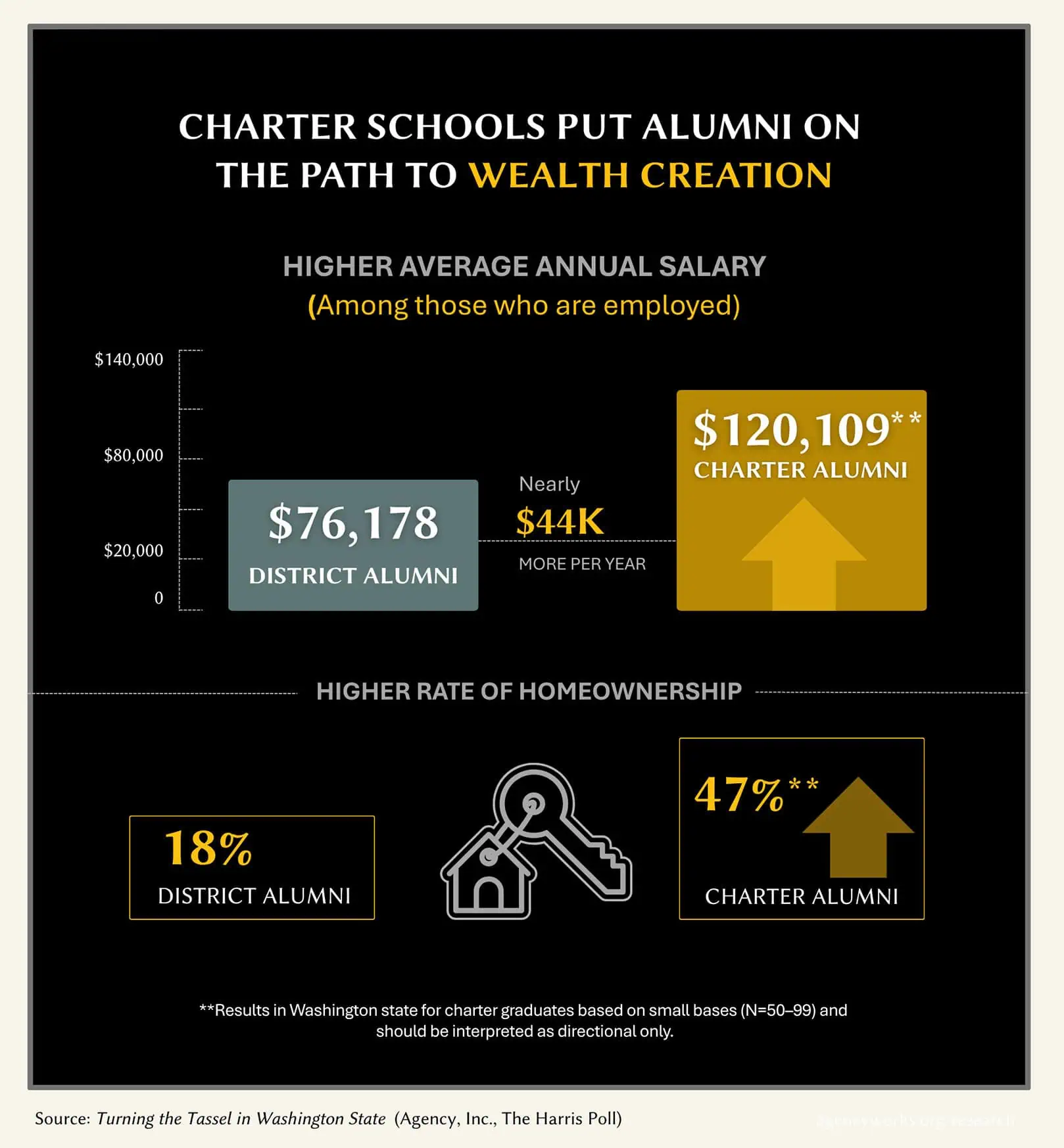
- Higher annual salaries ($120,109** on average vs. $76,178 for district school graduates—a nearly $44,000 difference)
- Higher home ownership (48%** vs. 18% of their district school peers)
Nearly $63,000 more per year in salary on average for Black, Latino, - Hawaiian/Pacific Islander and Native American alumni than their district school peers ($132,611** vs. $69,714**, respectively).
Because charter public schools are so new in Washington, and these schools serve less than one-half of 1% of all public school students, there are only a small number of graduates so far—creating a small sample size for this study.
And even with these caveats, the outcomes are phenomenal and deserve attention.
As Washington looks to the future, the opportunity is clear: identify what’s working in public education—and expand it so more students can benefit.
**Because this is a base that falls between 99 and 50, data is considered “directional only”—meaning that the data can suggest the “direction” or the general pattern or trend, but it cannot be used to measure the exact magnitude of that pattern, due to the size of the sample.
Follow Us

The Bark Benefit is changing lives, one rescue at a time
Every rescue dog has a story.
Tickets for The Bark Benefit are available now. September 19, 2026 | Meydenbauer Center Some animals arrive with broken bones or other medical needs. Others carry wounds that can’t be seen: fear, neglect, or trauma in need of healing. And then there are the dogs who have simply found themselves without a home because life…


From Prison, With Purpose: A Podcast From the Inside
After spending nearly five years incarcerated at the Washington State Penitentiary, Vik Chopra emerged with a strengthened sense of self and the resolve to change the narrative surrounding the justice-impacted community. Now, he runs one of the few prison-produced podcasts in the country.
Meet Vik Chopra, the Seattle visionary behind "Concrete Mama," Washington’s first prison podcast. Discover his journey from incarceration to empowering justice-impacted voices through storytelling.

Powering Progress: Aina Abiodun on Climate Innovation That Serves Communities
As president and executive director of VertueLab, Abiodun is working to make climate tech more equitable, practical, and rooted in real human needs.
Meet Aina Abiodun, VertueLab’s executive director, who is championing equitable climate tech in Seattle and empowering communities to drive innovation.