





Visual Arts
Read More ›
Go See Diné Artist Eric-Paul Riege’s Largest Show to Date at the Henry Art Gallery
With a mix of mediums, ojo|-|ólǫ́ examines questions surrounding the authenticity and ownership of Indigenous work.
 By Rachel Gallaher-Zenz April 20, 2026

It’s a phrase that’s been drilled into most of us since we were young children: When you’re visiting a gallery, please, do not touch the art. In many cases, it’s with good reason: the pieces on display are fragile, one-of-a-kind, or historic works that cannot be reproduced. It’s such an ingrained approach to the museum-going experience, that on a recent visit to the Henry Art Gallery—a press preview for the opening of Diné artist Eric-Paul Riege’s exhibition, ojo|-|ólǫ́ (pronounced oh-ho hol-ohn)—when our group was told that we, in fact, could touch the art, everyone looked around in a moment of confusion.
“We are really inviting people to touch the work!” said Nina Bozicnik, senior curator at Henry Art Gallery. We were standing in the gallery’s largest room surrounded by hanging looms and layered, black-and-white textile sculptures. “As Eric-Paul was saying, these sculptures can carry the mark of all the people who interact with them. Here, we become part of the story, the material history that’s embedded in the objects.”
This idea of mutual exchange through physical interaction—the notion that when you touch something you change it, and it changes you—runs through much of Riege’s work. He thinks at both ends of a piece, from those who are behind the production of a material (the people who washed the sheep, carded the wool, and delivered it to the craft store, etc.) to the viewers who come see the piece once it’s installed. “All of these fingers are embedded within my material,” he says. “So, I consider them inherent collaborators.”
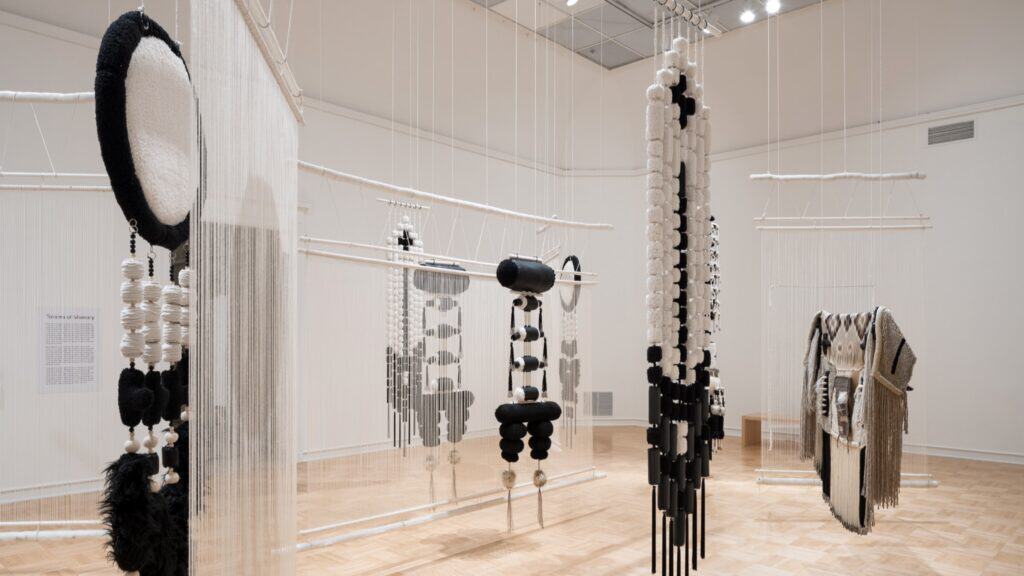
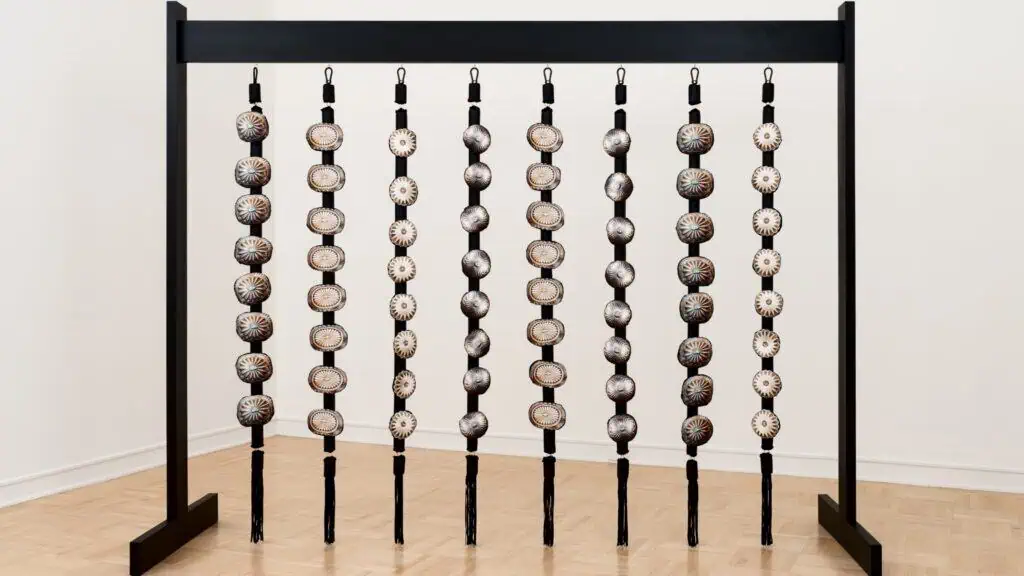
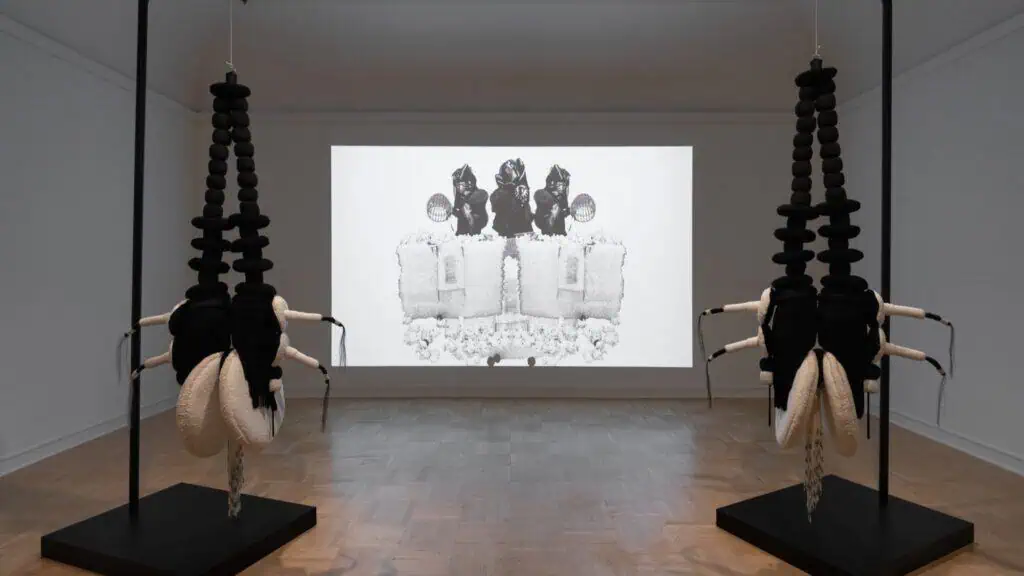
“My work is really modular,” he says. “A lot of parts are new, but then other parts [were] made 10 years ago and they are sewn directly on to each other. “Things get changed and moved all the time in my work … That’s something that I want to celebrate with objects that I consider living, is to have that accumulation of marks and tattoos and stitches and mending, because it has a lived history, both with me and separate from me and with [the viewer].”
Throughout the gallery, Riege plays with our expectations, often using materials such as plastic shower curtains or hair clips from Claire’s, that would traditionally be considered “lowbrow.” The fact that we can’t tell brings into question how we, and more importantly, who should, determine things like authenticity or value. Riege recalls a time when he was a student at the University of New Mexico in Albuquerque (he is currently based in Gallup, New Mexico), where he saw a news piece talking about how to spot fake Native art. “I watched this news article, and a lot of it was about material choice,” Riege recalls, “like inauthentic turquoise or tin versus sterling silver versus silver.”
In that moment, he started thinking about questions surrounding the concept of authenticity: What if a Native artist who comes from a family of makers can’t afford certain materials? What makes something fake or less authentic than the work of Native artists who can? “At the time, I was someone who also couldn’t afford to buy turquoise and silver, and I worked with fabric,” Riege says. “So, I started making beads and stones out of cheap fabric from the thrift store or Walmart or Joann Fabrics. I like taking something that was deemed natural stone or real silver, then making a fake version of it … I want to leave it up to the viewer to decide what they deem as real.”
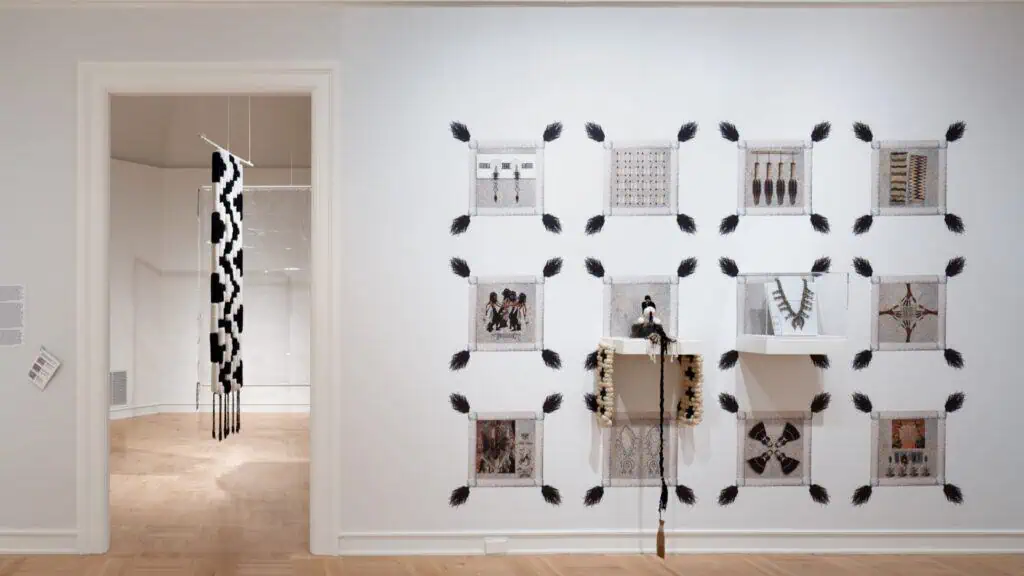
ojo|-|ólǫ́ is a celebration of Indigenous-made objects, and the history, culture, and labor that have gone into creating them for millennia. Riege makes the point that it doesn’t matter what a thing is made of; what is more important is the person and intention behind it, as well as the preceding stories, traditions, and artists that created its path forward. Perhaps objects aren’t static, and as such, they can take pieces of us—memories, emotions, hopes and dreams—along with them as they travel through hands and households and years.
Follow Us

SENSORIUM Takes on Our Screen Addiction
Dance, drag, and immersive art collide in an eight-week exploration of our phone-obsessed lives, with a few surprises along the way.
What do drag queens, smartphone addiction, art installations, and an old luggage shop have in common? According to longtime Seattle choreographer Alana O’Farrell Rogers, a lot. “There’s no dead time anymore,” says Rogers, explaining how the proliferation of smartphones fills the empty spaces that once served as time for rest or connection. Where we snuggled…

Salt-N-Pepa on Breaking Barriers and Staying Power
Ahead of their performance at Seattle’s Museum of Pop Culture gala, the hip-hop pioneers talk about creative ownership, connecting with new generations, and the songs that still resonate.
The Museum of Pop Culture (MOPOP) will host its annual ICONS of Pop Culture Gala in Seattle on October 22, honoring five artists and institutions whose work has helped shape entertainment and culture. This year’s honorees are martial arts and film legend Bruce Lee, fashion designer Jeremy Scott, the video game franchise Halo, hip-hop pioneers…

Studio Sessions: Christopher Paul Jordan
Drawing on childhood memories, neighborhood history, and salvaged materials, Christopher Paul Jordan’s latest show at Cornish’s Behnke Family Gallery explores how the past stays with us.
Start in the middle. It’s good advice for telling a story, and a way into Christopher Paul Jordan’s paintings. By the time you encounter them, their materials have already been something else, and who knows what they might move on to become. The Tacoma interdisciplinary artist works with salvaged objects, including screens, picture frames, canvas,…

Rearview Mirror: Wedding Bells, A Furniture Launch, and the Symphony’s New Look
Things I did, saw, ate, learned, or read in the past week (or so).
WEDDING BELLS I’ve been a bit absent from this column lately, but I think I have a pretty good excuse: I got married! It’s already been three weeks since my September 19 wedding, but I’m still reflecting on the magic of the day. My fiancé, well husband now (I can’t get used to saying it!),…