





Lifestyle
Read More ›
Capitol Curiosity
Free tours, fantastic architecture, and a 5-ton Tiffany chandelier make Olympia’s legislative building worth the trip.

Nothing says autumn like falling leaves, and the deluge of campaign flyers and attack ads. But there isn’t anything remotely political about taking a tour of the state capitol. You’re there to admire the neoclassical architecture, not to listen to partisan bickering. But first, why is the capital in Olympia? Seattle and Tacoma didn’t exist when Washington Territory was founded. In 1853, Olympia was the biggest city on the Puget Sound.
Every year, about 20,000 visitors and another 16,000 schoolchildren enter through the massive bronze doors of the legislative building in Olympia. “Does Trump live here?” is a perennial question. Sorry, kids—this is Washington state, not Washington, D.C.—but it’s easy to see how they could make that mistake.
The legislative building, completed in 1928, is designed to wow. It’s home to the tallest masonry dome in North America. Believe it or not, the only thing holding that dome together is gravity.
The legislative building, along with the capitol campus, is open to the public. There are 42 steps to the entrance, which is intentional because Washington is the 42nd state. You can wander around the building on a self-guided tour or join a 50-minute guided tour. It’s a really nice way to spend a day, and it’s all free. Even parking is free on weekends ($2 an hour on weekdays). Volunteer guides lead tours of the legislative building six times a day on weekdays and four times on weekends. No tickets or reservations are needed—just walk up to the information desk inside the main entrance. Tours take place nearly every day of the year, except for Thanksgiving, the day after Thanksgiving, Christmas, and New Year’s Day.
Tip: The capitol campus hosts 200 students a day from January to June. Visit outside those months for easy parking and a quieter experience.


When you step onto the rotunda floor, you’ll see why this space hosts proms and weddings in addition to bill signings and speeches. It’s impressive. Stand next to the state seal in the middle of the floor and look up 287 feet to the top of the cupola. You could set the Statue of Liberty on the seal and it’d fit in the building.
The light fixtures throughout the building are designed by Louis Comfort Tiffany—yes, as in Tiffany & Co. The world’s largest Tiffany chandelier hangs in the middle of the rotunda. At the time, it cost $1 per pound, so $10,000 for the 5-ton bronze chandelier.
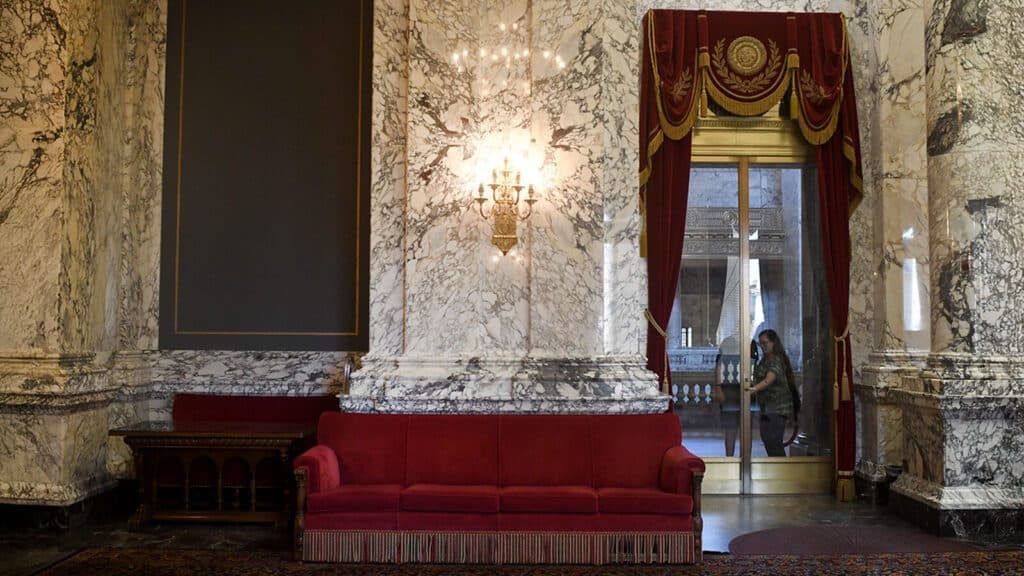
Another showstopper on the tour is the state reception room, which is used as a formal receiving room for dignitaries and curious tourists. The slabs of veined Italian marble on the walls act like a giant Rorschach test. Can you find the butterfly? How about the dead rat? If you play piano, you’re invited to try out the historic Blüthner piano in the corner.
This room is where legislators stop by to greet school groups. About 250 schools tour the capitol campus every year. “The kids ask the most interesting questions,” says Jamie Bassett, tours program supervisor. “They always want to know if there is any gold in the building.” Psst, there is, but it’s not super obvious. Look closely—the curtains in the state reception room contain a bit of gold thread.
If you email ahead, you can request free outdoor tours of the capitol’s memorials and horticulture. Each one is about an hour long. The memorial tour takes you to poignant monuments honoring Washingtonians who died in wars and in the line of duty.
The botanical tour takes you through the original plans by the Olmsted Brothers, the same landscape design firm behind New York City’s Central Park. “It’s a museum of trees,” says public tours supervisor Jesse Morrow. “There are a lot of trees on the tour.” You’ll visit the national champion English oak, the largest of its kind in the country. Outside the governor’s mansion are the three magnolias Gov. Gary Locke planted for his three children, and the dogwood Gov. Chris Gregoire planted for her daughter’s wedding.

While capitol tours are strictly apolitical, you’ll learn some fun trivia about our elected leaders. Did you know Gov. Bob Ferguson’s cat has his own Instagram page? Give the feline influencer a follow at @first.cat.peter. And if you’re looking for the governor himself, he’s the guy with the red JanSport backpack and the lime LaCroix.
Follow Us

SENSORIUM Takes on Our Screen Addiction
Dance, drag, and immersive art collide in an eight-week exploration of our phone-obsessed lives, with a few surprises along the way.
What do drag queens, smartphone addiction, art installations, and an old luggage shop have in common? According to longtime Seattle choreographer Alana O’Farrell Rogers, a lot. “There’s no dead time anymore,” says Rogers, explaining how the proliferation of smartphones fills the empty spaces that once served as time for rest or connection. Where we snuggled…

Salt-N-Pepa on Breaking Barriers and Staying Power
Ahead of their performance at Seattle’s Museum of Pop Culture gala, the hip-hop pioneers talk about creative ownership, connecting with new generations, and the songs that still resonate.
The Museum of Pop Culture (MOPOP) will host its annual ICONS of Pop Culture Gala in Seattle on October 22, honoring five artists and institutions whose work has helped shape entertainment and culture. This year’s honorees are martial arts and film legend Bruce Lee, fashion designer Jeremy Scott, the video game franchise Halo, hip-hop pioneers…

Studio Sessions: Christopher Paul Jordan
Drawing on childhood memories, neighborhood history, and salvaged materials, Christopher Paul Jordan’s latest show at Cornish’s Behnke Family Gallery explores how the past stays with us.
Start in the middle. It’s good advice for telling a story, and a way into Christopher Paul Jordan’s paintings. By the time you encounter them, their materials have already been something else, and who knows what they might move on to become. The Tacoma interdisciplinary artist works with salvaged objects, including screens, picture frames, canvas,…

Rearview Mirror: Wedding Bells, A Furniture Launch, and the Symphony’s New Look
Things I did, saw, ate, learned, or read in the past week (or so).
WEDDING BELLS I’ve been a bit absent from this column lately, but I think I have a pretty good excuse: I got married! It’s already been three weeks since my September 19 wedding, but I’m still reflecting on the magic of the day. My fiancé, well husband now (I can’t get used to saying it!),…