





Lifestyle
Read More ›
Public Art Plays the Long Game for the World Cup in Seattle
The city is using the tournament to build a creative legacy through murals, installations, walking tours, and interactive storytelling.

This article originally appeared in the May/June 2026 issue of Seattle magazine.
On a stretch of sidewalk in downtown Seattle this summer, you might notice a small vinyl marker shaped like a drop of water. Scan it with your phone, and the street will begin to shift—plants might bloom across the pavement, animals crawl or slither, water cascades, and stories unfold. Follow the next marker, and the next, and you’re moving through a different kind of FIFA World Cup experience—one that turns the city’s streets into a stage for storytelling.
As Seattle prepares to host six matches at Lumen Field, the city is investing not only in infrastructure and fan zones but also in a wide-ranging slate of public art meant to animate streets, neighborhoods, and public spaces. Through programs such as the World Cup 2026 Community Celebrations and a series of downtown activations called We Still Dream a Future, the city has funded free festivals, installations, and performances designed to reflect Seattle’s cultural breadth.
The most visible of those efforts will unfold downtown and in Pioneer Square, where large-scale projects aim to meet visitors where they already are—walking, gathering, and exploring between games. One of the most ambitious is Future Arts Way, a 2.5-mile interactive route linking Seattle Center to King Street Station. Developed by the nonprofit Future Arts, the project uses augmented reality to layer digital storytelling onto physical sites, connecting visitors to local small businesses, Coast Salish histories, and color-splashed artworks along the way.
“This is truly an effort to bring important untold stories that have been living in this land for a very long time … back onto the land using technology,” says Future Arts executive director Yuliya Bruk.
The heart of the route is a major installation at Third Avenue and Pine Street. Titled Other Earth 2026, it combines large-scale vinyl, augmented reality experiences, and hand-painted murals to present hypnotic artwork inspired by perspectives that have traditionally been “othered.” Drawing on Coast Salish ecological knowledge, Afrofuturist design, and ethnobotanical research, the installation imagines a downtown landscape where water, plant life, and ancestral histories resurface through both physical and digital layers.
“We want visitors and residents to see a city that feels alive with possibility—where art, culture, and community are not just on display, but are happening all around them.”—Kate Fernandez, Downtown Activations Supervisor
Elsewhere along the route, visitors encounter smaller launch points—QR-coded markers that unlock location-specific artworks and narratives. The experience can be as brief or as immersive as one chooses, whether pausing at a single stop or walking the full path through Belltown, downtown, and Pioneer Square.
“Our goal is to put things out there that leave a lasting memory and leave someone changed,” Bruk says.
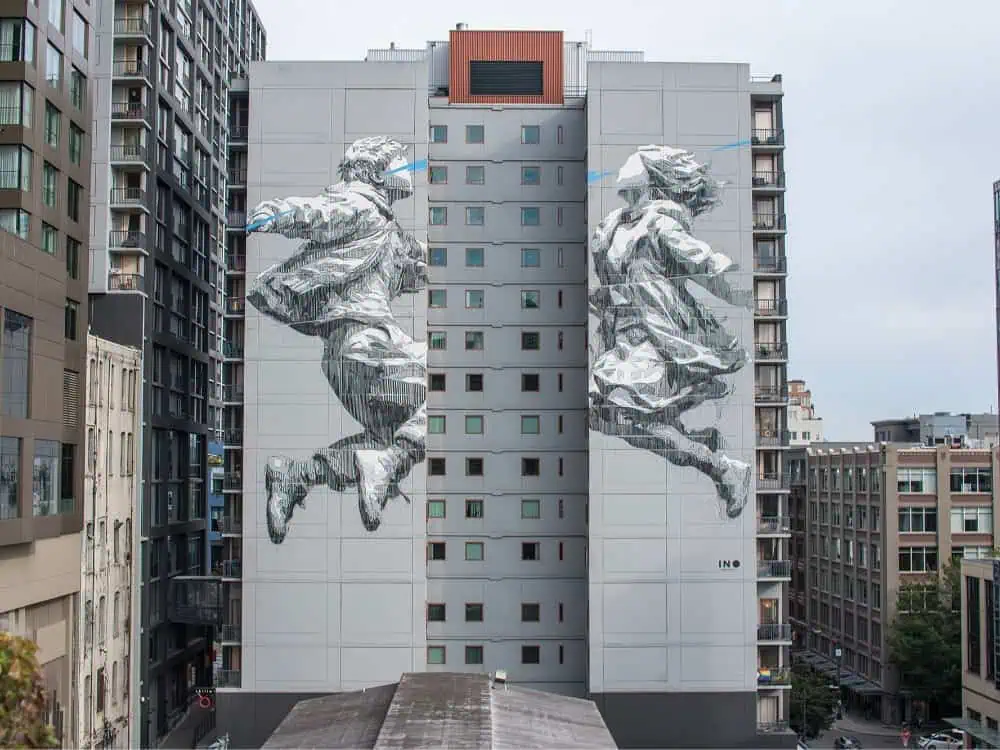
Future Arts Way is just one piece of a broader downtown effort. Earlier this year, the Unity Loop mural project unveiled two gargantuan-scale works to the city’s urban core. The blue-green waves of United Currents by Seattle artist Leo Shallat now grace a wall at Spring Street and Fifth Avenue, while two young figures in grayscale leap 17 stories at 1306 Western Avenue in the United by Nature mural by Greek artist INO. Produced by Street Art for Mankind, the works are designed to reflect themes of counterculture, human rights, and civic unity, positioning Seattle as both a creative capital and a welcoming global city.
Meanwhile, just outside Lumen Field, the 9-foot-tall Vital Spirit sculpture by Gerard Tsutakawa adds another focal point. The undulating bronze (one side jagged, one side gentle) represents “the coming together of the peoples of the world,” according to Tsutakawa. It’s designed to welcome visitors while reflecting the energy and movement of the surrounding stadium district.
“We want visitors and residents to see a city that feels alive with possibility—where art, culture, and community are not just on display, but are happening all around them,” says the city’s Downtown Activations supervisor, Kate Fernandez. “Whether it’s a large-scale installation, a live performance, or a spontaneous dance workshop, the goal is for visitors to feel that they’ve stepped into a shared civic experience—one that is imaginative, welcoming, and deeply human.”
That same ethos carries into the many smaller, more intimate projects funded through the city’s We Still Dream a Future initiative. In Chinatown–International District, for example, writer and artist Taha Ebrahimi (author of Street Trees of Seattle) and Vanishing Seattle founder Cynthia Brothers are leading a series of free walking tours from June to September that weave together neighborhood history and urban forestry. Participants will learn about migration, displacement, and resilience through both first-person stories and the living landscape of notable trees, including what might be the largest loquat tree in the state.
“At its root, community is developed in person, locally,” Ebrahimi says. “As our city continues to grow and attract new people, we want to ensure a future that celebrates the people and places that came before us.”
That balance—between global attention and local meaning—runs through many of
the projects tied to the World Cup. While the event is expected to attract hundreds of thousands of visitors to Seattle, much of the art has been designed with a longer horizon in mind.
For Bruk, that future-facing perspective is essential. “We wanted to make sure Seattle showed up in the world’s eye as being grounded in technology that really uplifts cultural stories,” she says, “and that our community is left with something that we feel proud of afterward.”
If these efforts succeed, the legacy of the World Cup may not just be measured in attendance or revenue, but in something less tangible—how the city chose to tell its own story while the whole world was watching.
Follow Us

Finding Fortitude Through Triathlon
More than 2,000 athletes will take on IRONMAN 70.3 Washington Tri-Cities Sept. 20, testing their endurance—and finding benefits that go far beyond physical fitness.
In 2005, Jennifer Comfort was a new mom who wanted some exercise. She joined a gym, where she met a fellow Jen who had just done a triathlon. Comfort had no idea what that meant—it’s a sporting event with a swim, bike, and run component—but she signed up for one anyway. “I doggy-paddled the swim,…

Helsinki is Like Seattle—Only More Hockey-Obsessed
As the Kraken head to Finland in November for their first regular-season games outside North America, Seattle fans will find ferries, coffee, craft beer and a familiar devotion to life by the water.
We were maybe 15 minutes into our inaugural Helsinki stroll when my kid asked the question my jet-lagged brain had mulled over but filed under “later”: “Where are all the cars?” We were walking down Esplanadi on a bright June evening near the summer solstice, and the street noise was mostly gulls and the whine…

Who Let the Dogs In? The Mariners’ Bark at the Park Is Seattle at Its Best
Baseball is better with a few hundred dogs in the stands.
Every so often, a city reveals its personality in the smallest and most delightful of ways. In Seattle, that might just be a baseball game … with dogs! The Seattle Mariners host “Bark at the Park” several times each season at T-Mobile Park, and if you haven’t been, you’re missing out on a high dose…

Why I Built a Pickleball Club With My Daughter
My father showed me how to turn my love of sports into something lasting. Pickle at the Palms carries that lesson forward.
Looking back, I wouldn’t say my family teaming up to launch Pickle at the Palms—a new 20-court indoor pickleball club—was inevitable, but it may have been predictable. Sports have shaped my life for more than 50 years. I fell in love with rowing as a 17-year-old college freshman and went on to compete on two…