





Arts
Read More ›
Pieces of a Ferry: The Story of the Kalakala
Remembering 'the workhorse of Puget Sound'

This article originally appeared in the November/December 2024 issue of Seattle magazine.
People often ask how I manage to find so many historical treasures, and quite honestly, it’s often just a matter of dumb luck. Case in point: Several months back I decided to stop at a random garage sale while out running errands. Nothing initially grabbed my eye, but on the way out I noticed an old Mason jar full of random vintage trinkets with a “$2 for everything” price tag. With a shrug of the shoulders, I impulsively picked it up as a bit of a mystery purchase. It was likely full of worthless junk, but if nothing else it would provide me with a few minutes of cheap entertainment.
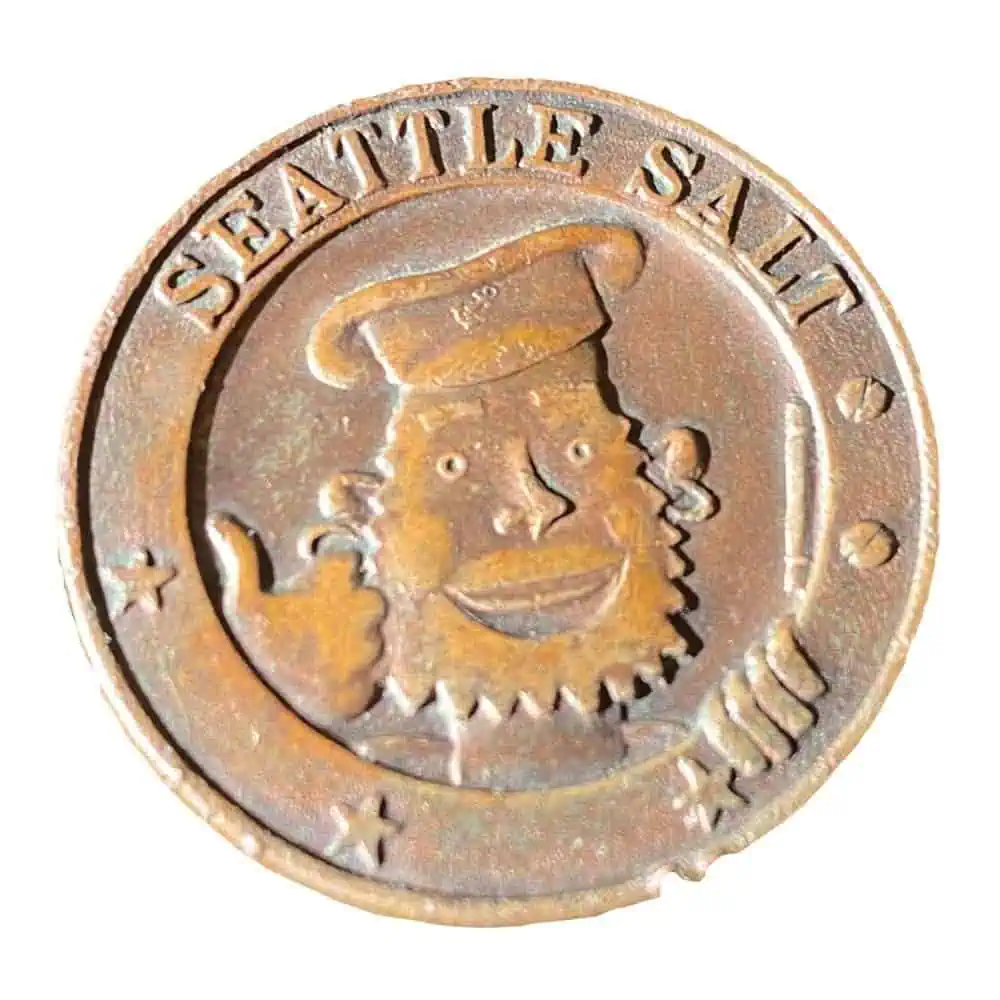
After arriving home, I brought the glass jar to my backyard and dumped its contents out on a picnic table. As suspected, it was mostly invaluable bric-a-brac: an old door hinge, various screws and nails, a broken mechanical pencil, and assorted detritus that was likely from some long-ago workshop. Then I noticed a coin. It was covered with gunk, but after giving it a good spray with the garden hose and wiping it down I realized that I had found the proverbial diamond in the rough.
A quick Google search confirmed that the coin was actually a novelty token from the 1930s that had once been handed out to children visiting the Salt Cafe — an ornate lunch counter that occupied the main floor of the legendary Seattle ferry the MV Kalakala. It’s an eye-catching piece of local history, with the front of the coin featuring an old-time sailor looking out of one of the ship’s porthole windows, while the back shows the iconic ferry out on Elliott Bay with the words “Greater Seattle” etched on top.
One reporter breathlessly declared the Kalakala to be “the most important vessel since Noah’s ark.”
For those unfamiliar with this famous ship, the Kalakala operated from 1935 until its retirement in 1967 and, during its heyday, was one of the city’s most popular attractions. She was a classy ferry with various luxurious amenities, including velvet-upholstered chairs, a double horseshoe lunch counter, and its own eight-piece orchestra. What truly made the Kalakala so unique, though, was its stylish, silver-hulled exterior considered by many to be an art deco masterpiece. In fact, the Kalakala is a Chinook-derived word meaning “flying bird” — a direct reference to its curved and sweeping design.
When it was first unveiled, the Kalakala’s eye-catching appearance quickly gained worldwide recognition, appearing on billboards, photographs, and news-reels all over the world, with one reporter breathlessly declaring it to be “the most important vessel since Noah’s Ark.” Numerous celebrities and politicians of the day had their photographs taken aboard the ferry, and it quickly became a popular attraction for locals and tourists alike.
For most of its lifespan, the Kalakala serviced the Seattle-to-Bremerton route, transporting more than 1 million passengers a year. This included thousands of sailors and yarders who, during World War II, relied on the Kalakala to bring them back and forth to the naval shipyards each day. This, in turn, led to its moniker, “The Workhorse of Puget Sound.”
After the war, the Kalakala continued to serve as a reliable ship, though newer and bigger ferries, such as the Chinook, were starting to be introduced. Additionally, cars became wider in the postwar years, making the Kalakala less efficient as she was able to carry fewer and fewer cars due to their increasing size. The Kalakala soon found itself demoted from the company flagship and, with the arrival of a more efficient ferry fleet, the Kalakala slowly became obsolete. The ferry enjoyed a brief resurgence during the 1962 Seattle World’s Fair in which it drew almost as many visitors as the Space Needle.
As time wore on, though, the Kalakala grew increasingly expensive to operate and was finally retired from service in 1967. It was eventually auctioned off to a seafood processing company and towed to Alaska to be converted into a crab cannery. A few years later it was moved to Kodiak Island, where it continued to operate as a processing plant. A couple decades later, a Seattle businessman spotted the forgotten ship while traveling through Alaska and immediately began formulating a plan to return it to Puget Sound. After several years of complicated financial negotiations, the Kalakala was eventually towed back to Seattle in 1998, with the new owner hoping to restore the famous ferry back to its former glory.
Unfortunately, those dreams were never realized, and the ship continued to deteriorate. Unable to raise the funds required to keep it moored on Lake Union, much less for a restoration, the ship was sold and relocated to Tacoma, where it sat in neglect for another decade. The rusting ship was eventually scrapped in 2015, with all the remaining pieces sold at a very well-attended auction. Local businesses and souvenir hunters snatched up every available part within a matter of hours.
Some of the largest pieces were purchased by the town of Kirkland as the vessel had originally been built at the Kirkland Shipyards, so a direct historical connection existed between the city and the famous ferry. A few years ago, some of these parts were used in a public art piece titled Kalakala in Flight. Designed by local artist Amber Mikluscak, the large-scale artwork can be found at Feriton Spur Park, near the Cross Kirkland Corridor trail.
Several Kalakala parts were also purchased by the owner of Salty’s on Alki Beach. The popular West Seattle eatery managed to acquire the wheelhouse, as well as a massive rudder and crank, and has them on display out in its parking lot. The wheelhouse has been strategically placed so that visitors can stand inside and look across Elliott Bay to downtown Seattle. Additionally, a set of stairs from the Kalakala is currently on display at the Tacoma maritime history museum at the Foss Waterway Seaport. Pieces of the engine, including the crankshaft, can be seen at the King Agriculture Museum in Centralia.
While the physical body of the Kalakala no longer exists, pieces of its rich history continue to pop up, such as the token I recently found. These are a testament to the iconic ship’s lasting legacy, which continues to stir our imagination and prove that it has not yet run out of stories to tell.

Brad Holden is an amateur historian and is the author of two books: Seattle Prohibition: Bootleggers, Rumrunners and Graft in the Queen City, and Alfred M. Hubbard: Inventor, Bootlegger and Psychedelic Pioneer. Check out his Instagram/seattle_artifacts for more interesting tidbits about Seattle’s history.
Follow Us

SENSORIUM Takes on Our Screen Addiction
Dance, drag, and immersive art collide in an eight-week exploration of our phone-obsessed lives, with a few surprises along the way.
What do drag queens, smartphone addiction, art installations, and an old luggage shop have in common? According to longtime Seattle choreographer Alana O’Farrell Rogers, a lot. “There’s no dead time anymore,” says Rogers, explaining how the proliferation of smartphones fills the empty spaces that once served as time for rest or connection. Where we snuggled…

Salt-N-Pepa on Breaking Barriers and Staying Power
Ahead of their performance at Seattle’s Museum of Pop Culture gala, the hip-hop pioneers talk about creative ownership, connecting with new generations, and the songs that still resonate.
The Museum of Pop Culture (MOPOP) will host its annual ICONS of Pop Culture Gala in Seattle on October 22, honoring five artists and institutions whose work has helped shape entertainment and culture. This year’s honorees are martial arts and film legend Bruce Lee, fashion designer Jeremy Scott, the video game franchise Halo, hip-hop pioneers…

Studio Sessions: Christopher Paul Jordan
Drawing on childhood memories, neighborhood history, and salvaged materials, Christopher Paul Jordan’s latest show at Cornish’s Behnke Family Gallery explores how the past stays with us.
Start in the middle. It’s good advice for telling a story, and a way into Christopher Paul Jordan’s paintings. By the time you encounter them, their materials have already been something else, and who knows what they might move on to become. The Tacoma interdisciplinary artist works with salvaged objects, including screens, picture frames, canvas,…

Rearview Mirror: Wedding Bells, A Furniture Launch, and the Symphony’s New Look
Things I did, saw, ate, learned, or read in the past week (or so).
WEDDING BELLS I’ve been a bit absent from this column lately, but I think I have a pretty good excuse: I got married! It’s already been three weeks since my September 19 wedding, but I’m still reflecting on the magic of the day. My fiancé, well husband now (I can’t get used to saying it!),…