





Arts
Read More ›
Unmatched Ingenuity
Edwin Fountain’s artistic innovations can be seen all over south Seattle

This article originally appeared in the May/June 2024 issue of Seattle magazine.
It was a beautiful, clear morning in late October, and if you were walking your dog by Stan Sayres Memorial Park in South Seattle, or driving on Lake Washington Boulevard South, you would have seen him.
A spry gentleman in his 60s, perched in the elbow of a madrona tree, about 9 feet up.
This tree is dead — Seattle Parks and Recreation had decapitated it — but to Edwin Fountain, it is a canvas. A piece of marble. A sculpture waiting to emerge.
I ask him what it’s going to be.
“I don’t know,” he says. “I’m waiting for it to tell me.”
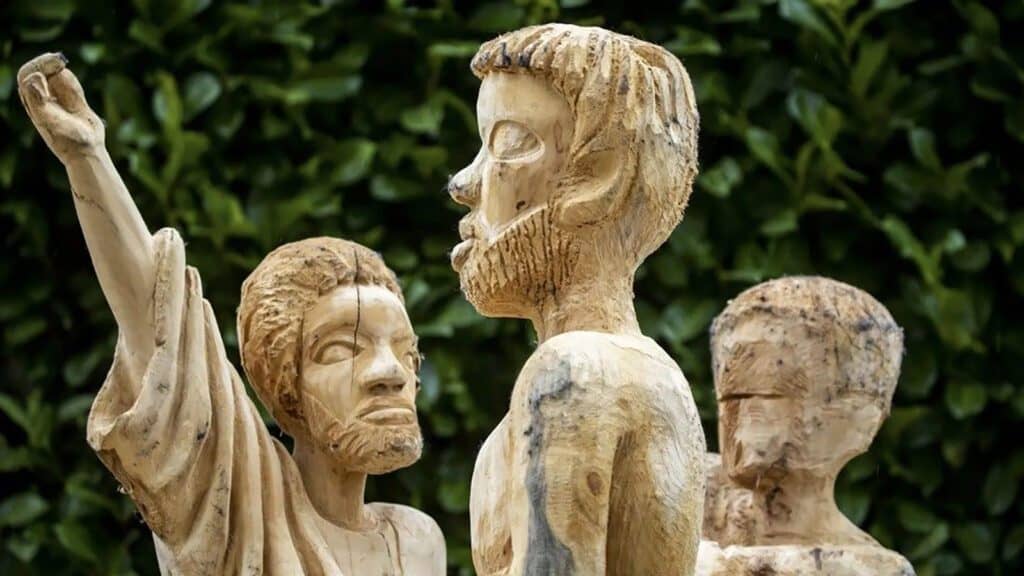
You can find Fountain’s tree sculptures all over South Seattle, especially in the Mount Baker and Beacon Hill neighborhoods. A cluster of peaceful faces is carved into maple tree stumps on the path to the tennis courts at Mount Baker Park. There’s a madrona sculpture garden at the foot of Colman Park, just south of the cottages built by famous Seattle architect Ellsworth Storey.
“I did it to slow down the traffic,” Fountain says, only half-jokingly.
On this October morning by Stan Sayres Park, both the walkers and the drivers stop to look.
People smile at him. Some of them linger. A young woman with a black standard poodle walks by on the lake path. “I’ve been watching you work all over the place,” she says.
As Fountain climbs up the ladder to sit in the elbow of the tree, his neighbor Doug Knopp comes by with his dog. “It’s a little precarious, be careful,” Knopp cautions. People honk as they drive by. “I love your work!” somebody shouts from a station wagon.
Fountain waves. He smiles. He goes back to work. He is using a chainsaw, but he is handling it very gently, shaving thin slices of wood, talking to himself. He climbs down and walks around the tree to scrutinize his progress.
“That’s an arm,” he says to himself. “And a face.”
Maple, oak, cherry, hickory — Fountain has created sculptures from all kinds of wood, but madrona is his favorite. “It carves up sweet and has a beautiful color,” he says.
There were no madrona trees in rural Conecuh County, Ala., where Fountain grew up. But there was clay — “beautiful red clay” — in the soil on his grandfather’s 80-acre cotton farm, where Fountain and his six siblings spent most of their summers. He and one of his younger brothers, Donald — who is also an artist — loved to make sculptures from that clay.
They were idyllic summers.
“I learned how to plow, shuck peanuts, grind sugar cane, pick cotton,” Fountain recalls.
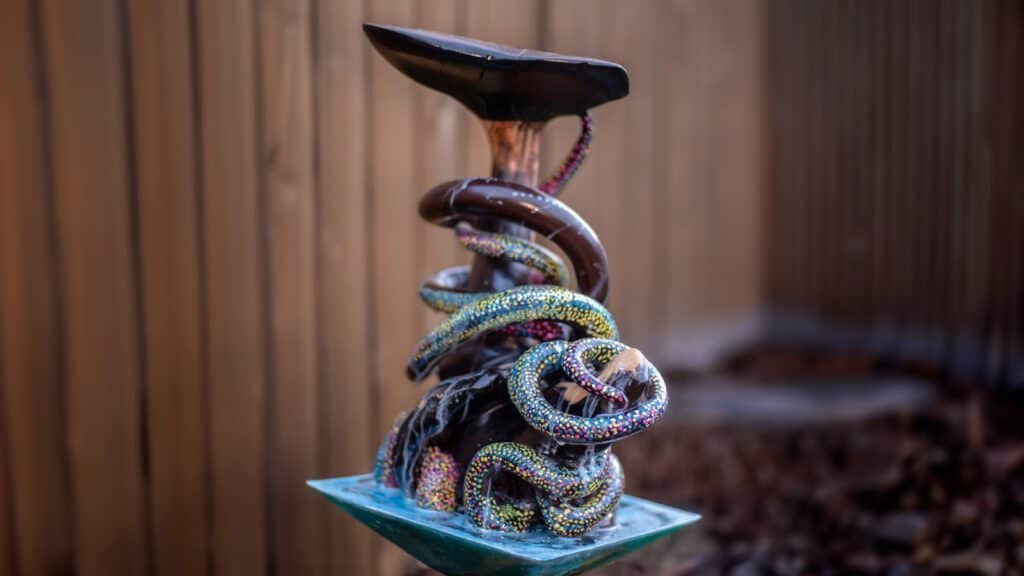
His grandfather, Alonzo Salter, worked very long hours on the farm, but Fountain remembers him “always making something, weaving a basket, making a plow, and then he’d sit down late at night and doodle a bit.”
That farm was in Burnt Corn, Ala., only a few miles from Harper Lee’s hometown of Monroeville, the model for the fictional town of Maycomb in To Kill A Mockingbird. Fountain and his siblings grew up there in the 1960s, just a few years after that iconic book was published. But to Edwin, Donald, and the other kids, Monroeville was light years away from the farm in Burnt Corn.
“Blacks and whites down there, they was cordial,” Donald recalls. “We never seen any cross burning, any Klan activity, none of that.”
How could that be? Fountain credits his grandfather for creating a positive spirit in the town.
“Everybody knew him. Everybody looked up to him,” he said.
Go West
In 1977, most of Fountain’s family moved to Seattle, so that his mother, Shelby Leonard, could care for her brother’s six young children after his wife died of cancer. Shelby is 87 now, and she still lives in the same house, in Seattle’s Mount Baker neighborhood, along with Fountain’s stepfather, Jeff Leonard, and a 40-yearold parrot named Baby. Several years ago, after his wife died, Fountain moved in too, and he looks after his parents.
He also takes care of the house. He has replaced the roof, refinished the floors, and stripped 14 layers of paint off the dining room ceiling to reveal the beautiful old growth pine underneath it. He sees the house as just another “canvas to work on.” His lair is on the second floor, and there are paintings and sculptures everywhere. It is where he sleeps — not more than three or four hours a night — and also where he paints.
Outside the house, the front porch and driveway are crammed with wood carvings. Inside, in the living room, there’s a striking, 4-foot-tall sculpture of a woman emerging fully grown from the wood. In the center of the dining room table, there’s a whale’s tail carved from hickory. Fountain doesn’t know how many sculptures he has, and he has no names for any of them. There are just too many.
Fountain spent most of his working life as a building contractor, but 16 years ago he had a construction accident, and ended up on disability. Since then, he has spent much of his time on his artwork. But he’s not much interested in commissions, and he has had only one art show, in downtown Kirkland in 2019. Neither he nor his brother, Donald, have made much money from their artwork, and neither of them seem to care.
“We do it more for the love of it than for the financial gain or recognition,” Donald says.
Defying Death
Last summer, Fountain was sculpting a huge madrona log which was lying at the bottom of Colman Park, close to the Ellsworth Storey cottages where his friend, Libby Hall, lives. He and his younger brother Marty were attempting to pull the log to a standing position so he could finish his creation. Marty was using a block and tackle.
“I was standing watching him hook it up and I started getting tired,” Edwin says. “I couldn’t get enough air.”
Libby was watching them work, and she saw him fall. “He was writhing on the ground,” she recalls. “I went out to talk to him, comfort him.” Someone had called 911, and several fire trucks and police cars showed up. Fountain landed in the hospital, where he stayed for several days, according to his daughter LaGina, a 34-year-old pharmacy technician who lives in Tacoma.
“He had troponin levels leaking into the blood where they’re not supposed to,” LaGina says, “and a blockage in the stent.” (Troponin is a protein whose presence in the blood can indicate a heart attack or other heart problems, according to the Cleveland Clinic.)
It wasn’t the first time heart trouble has taken Fountain to the hospital. It has happened several times before. Fountain has a misshapen heart. It is shaped like a “V” on the bottom instead of like a cup, and that impedes the proper pumping of blood. He has taken blood thinners for a long time, and several years ago the doctors put a stent in his heart.
His daughter supervises his medical visits, and she really wishes he would slow down. “He’s less concerned with himself and more concerned with his parents,” LaGina says. “Like many dads, (he says) don’t worry about me.”
But maybe Fountain knows something the doctors don’t. He was 23 years old when his heart condition was diagnosed. The doctor told him then he wouldn’t live to be 25.
“I’m 66, ha-ha,” he says now, grinning. Perhaps he has a guardian angel, one named Alonzo Salter, helping him overcome all sorts of obstacles.
“What he taught me, there is no limitations,” Fountain says. “It’s about character. What you choose to be with your life.”
Follow Us

SENSORIUM Takes on Our Screen Addiction
Dance, drag, and immersive art collide in an eight-week exploration of our phone-obsessed lives, with a few surprises along the way.
What do drag queens, smartphone addiction, art installations, and an old luggage shop have in common? According to longtime Seattle choreographer Alana O’Farrell Rogers, a lot. “There’s no dead time anymore,” says Rogers, explaining how the proliferation of smartphones fills the empty spaces that once served as time for rest or connection. Where we snuggled…

Salt-N-Pepa on Breaking Barriers and Staying Power
Ahead of their performance at Seattle’s Museum of Pop Culture gala, the hip-hop pioneers talk about creative ownership, connecting with new generations, and the songs that still resonate.
The Museum of Pop Culture (MOPOP) will host its annual ICONS of Pop Culture Gala in Seattle on October 22, honoring five artists and institutions whose work has helped shape entertainment and culture. This year’s honorees are martial arts and film legend Bruce Lee, fashion designer Jeremy Scott, the video game franchise Halo, hip-hop pioneers…

Studio Sessions: Christopher Paul Jordan
Drawing on childhood memories, neighborhood history, and salvaged materials, Christopher Paul Jordan’s latest show at Cornish’s Behnke Family Gallery explores how the past stays with us.
Start in the middle. It’s good advice for telling a story, and a way into Christopher Paul Jordan’s paintings. By the time you encounter them, their materials have already been something else, and who knows what they might move on to become. The Tacoma interdisciplinary artist works with salvaged objects, including screens, picture frames, canvas,…

Rearview Mirror: Wedding Bells, A Furniture Launch, and the Symphony’s New Look
Things I did, saw, ate, learned, or read in the past week (or so).
WEDDING BELLS I’ve been a bit absent from this column lately, but I think I have a pretty good excuse: I got married! It’s already been three weeks since my September 19 wedding, but I’m still reflecting on the magic of the day. My fiancé, well husband now (I can’t get used to saying it!),…