





Outdoors
Read More ›
Summiting Mount Adams
Seattle magazine’s social media manager tackles a climb that tests both body and mind
 By Sarah Stackhouse August 12, 2025

Emma Smith, Seattle magazine’s social media manager, decided to climb Mount Adams in July, giving herself just a few weeks to prepare for an early August summit.
Mount Adams is a 12,276-foot stratovolcano in the Cascade Range, the second-highest peak in Washington, with sprawling glaciers and a broad, sloping summit. After her roommate mentioned the climb, Emma fell into a TikTok rabbit hole of summit videos—watching people travel across the country to tackle the peak. It looked beautiful and challenging, and she’s just impulsive enough to say yes.
She expected sore legs and stunning views. She didn’t expect spiders in the snow or the mental push it would take to keep going. We sat down with Emma to chat about her experience taking on such a big climb and how she prepared for it.
So, Mount Adams—how did it go? What surprised you the most about the hike?
Mount Adams was amazing! It was truly the hardest thing I’ve ever done in my life. I was naive going into it. I knew it would be physically challenging, but I didn’t realize how much of a mental challenge it would be, too. The beauty was breathtaking. What really surprised me was the amount of spiders in the snow. We started the summit at 3 a.m., and man, it was spider nation! I also really enjoyed the entire experience of backpacking and camping. It was fun to try something new.
What was the hardest part of the climb?
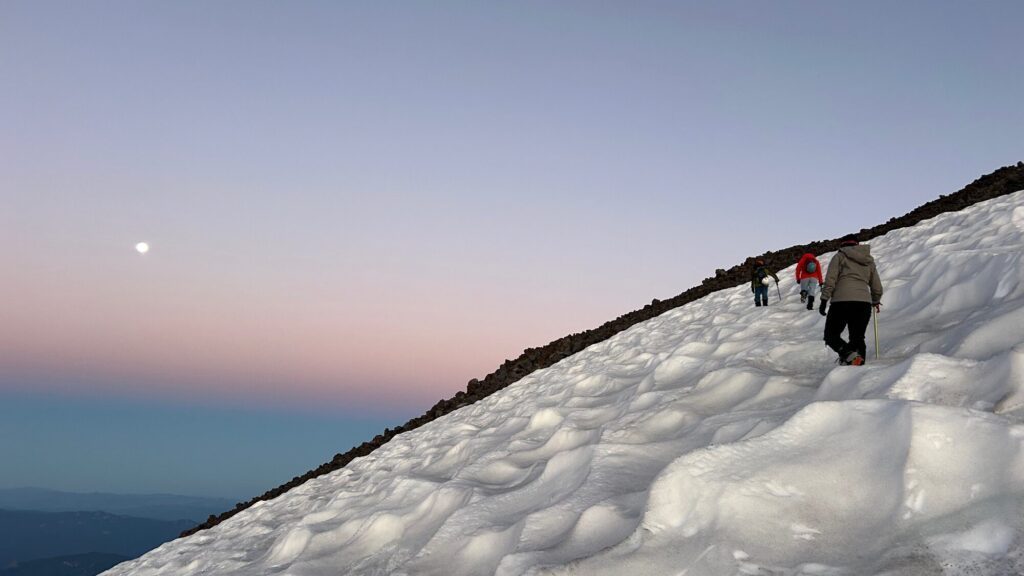
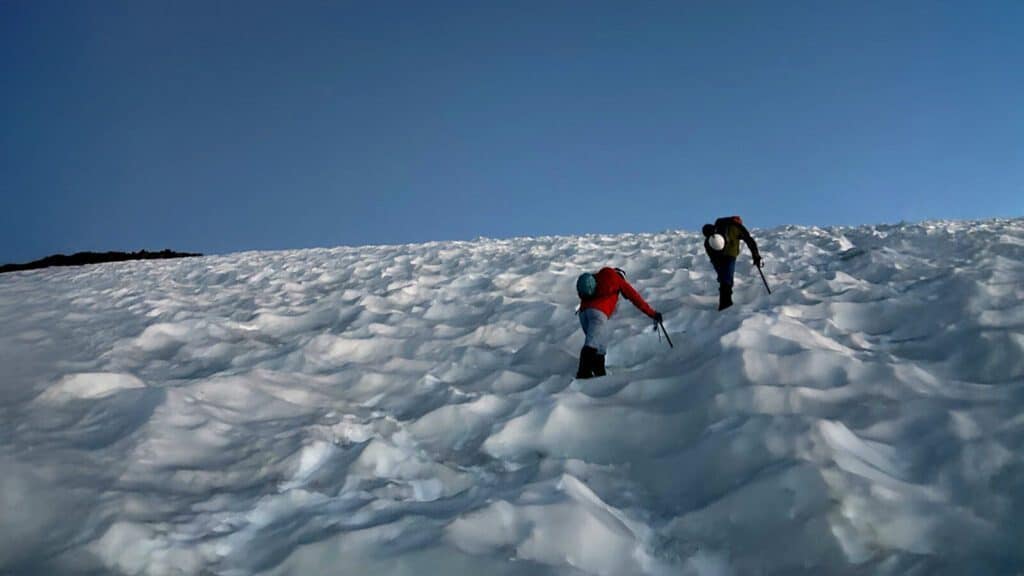
The hardest part was definitely the false summit. I knew it would be difficult, but I wasn’t prepared for the rocky sections. Normally, the climb is all snow with well-defined footsteps to follow, but because of the warm weather and the fact that we went later in the season, that wasn’t the case.
We had to create our own route up the mountain. With so little snow, we ended up climbing through a lot of rock fields. That was the only time I wanted to stop. I slid down some rocks and was terrified. Not to be dramatic, but I went into survival mode after that. We followed the rocks to another snow-and-ice patch, and I just kept thinking: step, breathe, ice axe, repeat.
This was your first time camping overnight. What was it like being in a tent?
Sleeping in a tent was humbling. I enjoyed it but I have to admit—it’s hard finding your stuff in there!
As someone who’s not a regular mountain climber, how did you prepare for this? Do you have any go-to tips or tricks?
I’m a runner and go on 4-7 mile walks a few times a week. In preparation, I went on a few runs and even ran up and down the rowing stadium stairs at Green Lake. If I could go back, I’d train with a backpack or extra weight and do a few local hikes like Poo Poo Point or Mailbox Peak.
Where did you source all the gear, and how did you know what to bring?
I rented my ice axe, crampons, and boots from REI in Seattle. It was super easy to get fitted after work and return them afterward. The process was quick and convenient, and the staff was incredibly helpful. My only note is that when I was there, I started to worry I might be unprepared—which isn’t far off.
What did you pack that you thought you’d need but didn’t? Or vice-versa—what do you wish you had brought?
I packed a pair of old ski gloves I didn’t end up needing. I used a lighter tech glove instead. I do wish I had packed a baseball cap—the sun is brutal, especially with the UV reflecting off the snow. I wore sunscreen but I was still nervous about burning. Overall, I packed very light and ended up using everything I brought.
Tell us about the day of the hike—how did it feel to finally be out there, and what were the “wow” moments?
Driving to the hike was such a fun start to the trip. We left Friday afternoon with plans to Summit on Sunday. We drove through Mount Rainier National Park, which was absolutely stunning. I didn’t realize just how far the drive would be, but I was glad I had my Kindle to pass the time.

We camped the night before and woke up at 6 a.m. to begin hiking. About two miles in, my friend told me we were halfway, which was nowhere close to the truth. Things got more challenging once we reached the first snowbank but I felt excited. Setting up camp that night on the mountain was a positive part of the experience—filtering water, preparing dinner, and settling in early since we planned to wake at 2 a.m. Luckily, I slept well.
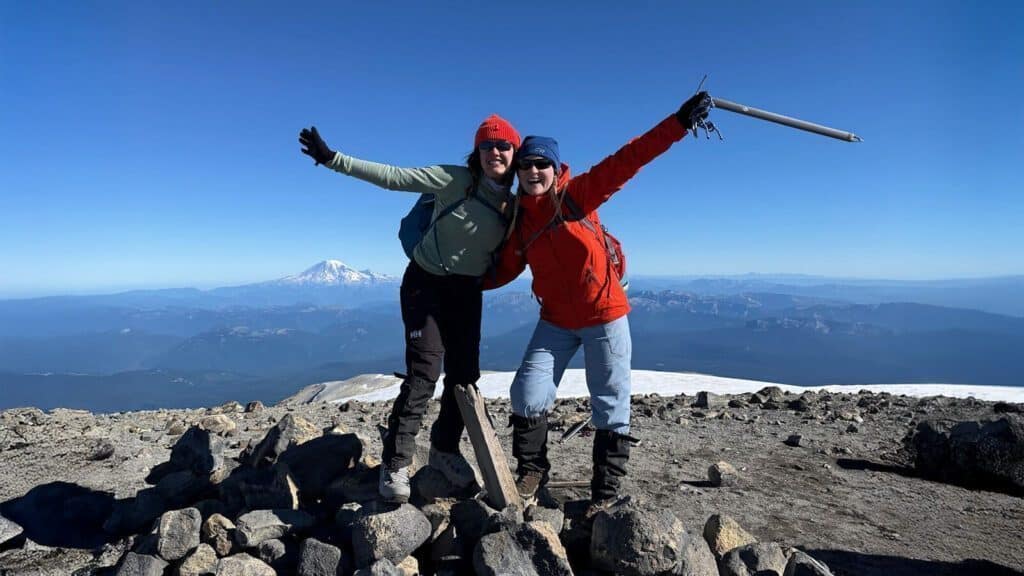
That morning, the wind was brutal. There was a moment at the false summit where I almost gave up, but I’m so glad I kept going. At the top the view was unbelievable—we could see Mount St. Helens, Mount Rainier, and Mount Hood all at once. My “wow” moment came with the sun rising and the sky being different shades of pink, blue, and purple.
Glissading down the mountain was both thrilling and terrifying. Returning to camp, packing up quickly, and hiking out after a long day on my feet was exhausting.
What was the most surprising feeling you had during the hike?
I’m a little afraid of heights, so I got scared when I was slipping down the rocks. I was also surprised by how emotional I felt after summiting. I broke my ankle last year, so I was proud of myself for pushing my limits.
Now that you’ve conquered Mount Adams, would you do a strenuous hike again? Any mountains on your radar?
Yes! I’d love to bring my skis next time and do it as a day hike so I can ski down. Mount Rainier is also on my list. We’re so lucky to have so many incredible outdoor adventures in Washington.
If someone’s thinking about tackling Mount Adams, what would you tell them?
Go with someone experienced. Safety is the most important thing. I wouldn’t have felt comfortable without experienced backpackers by my side.

Follow Us

A New Perspective on the Oregon Coast
Beyond the usual suspects like Astoria and Cannon Beach lie 300 miles of open road.
The Oregon Coast is a beguiling drive year-round, but autumn is when it feels most vital. The colors deepen, whales loiter in the shallows, and kites swoop against gray skies dappled with bursts of sunlight. At Tillamook Bay, Highway 101 veers inland through fifty miles of old-growth forest before re-emerging along the water. On this…

Inn at Langley: Where the Shore Meets the Sky
After a property-wide redesign, the Whidbey Island retreat reopens with a locally inspired take on vacationing in the Pacific Northwest.
Michelin-star chef Johnny Spero never planned to end up in the Pacific Northwest. A lifelong East Coaster born and raised in Baltimore, he began his culinary career at 16, working for a series of big-name chefs and restaurants before opening his own establishments in Washington, D.C., including Reverie, which earned him his Michelin star in…

The Northwest’s Gateway to Wine, Culture & Adventure
Escape the crowds. Slow down. Savor fall in the Lewis Clark Valley. As autumn paints the hillsides in gold, crimson, and amber, the Lewis Clark Valley becomes a picture-perfect place to slow down and savor the season. Where Washington and Idaho meet, fall brings crisp days, colorful landscapes, harvest among the vines, and plenty of…

Meet West Seattle’s “Freelance Beaver Detective”
A group of urban beavers helped Pamela Adams through a tough time. Now she’s returning the favor.
Pamela Adams was living in Port Townsend when her marriage fell apart. Little did she know at the time that she would soon find love again while doggedly pursuing the Five Families—not the ones of Mafia lore, but a four-legged sort living along the Longfellow Creek Watershed. Prior to moving to Washington, Adams resided in…